
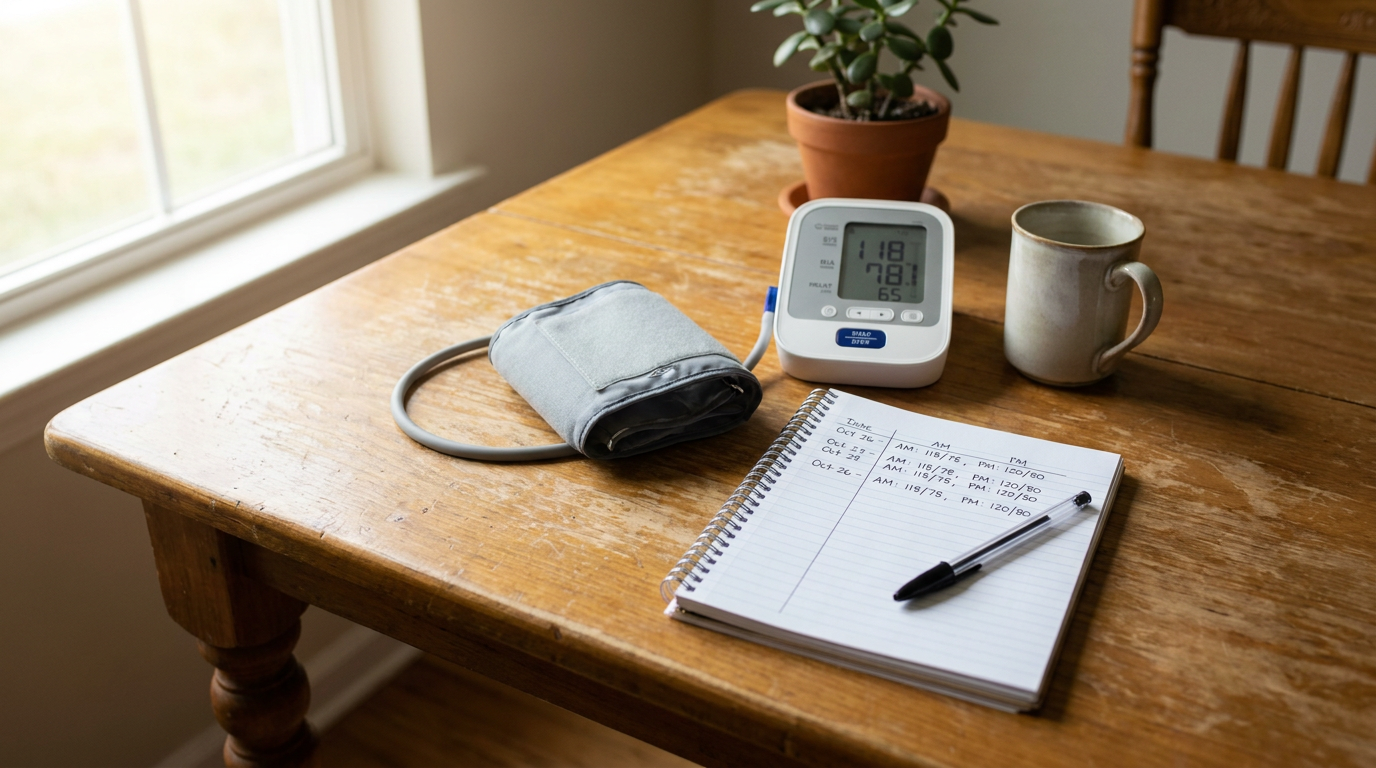
A blood pressure log only helps if every number in it was taken the same way. The routine matters more than the layout: bare arm, five minutes of quiet, cuff at heart level, two readings a minute apart.
This is general information, not medical advice. Your healthcare professional decides what your readings mean and whether anything about your treatment should change.
Why most home logs mislead the person reading them
The American Heart Association recommends home monitoring for everyone diagnosed with high blood pressure, and says it can also confirm a diagnosis of high blood pressure. Both depend on the home numbers being trustworthy.
Most are not. A reading taken over a sweater, right after coffee, or mid phone call can land in the wrong category. On paper, a rushed reading looks identical to a careful one.
The other common failure is the single scary number. The AHA asks for two readings one minute apart at every sitting. A lone reading can catch an ordinary minute-to-minute swing and file it as your pressure.
Video: American Heart Association
The AHA measurement routine, in order
Every step below comes from the AHA’s home blood pressure monitoring page. Do them in this order before you write anything down.
- Skip smoking, caffeinated drinks and exercise for 30 minutes beforehand. Empty your bladder.
- Remove clothing from the arm you will use. The cuff goes on bare skin, never over a sleeve.
- Sit with your back supported and feet flat, then rest quietly for at least five minutes. No talking, no phone.
- Rest your arm on a flat surface at heart level.
- Place the middle of the cuff at heart level on the upper arm, with the bottom edge just above the bend of the elbow.
- Take a reading, wait one minute, take a second reading.
- Write both readings down, at the same time of day every day.
The AHA recommends an automatic upper-arm cuff monitor and says wrist and finger monitors give less reliable readings. Take yours to your next appointment so the office can check it.
A log layout that records what the doctor needs
The AHA publishes a printable tracker, and a notebook laid out with these columns does the same job.
| Column | What you write | Why it belongs in the log |
|---|---|---|
| Date and time | The calendar date and the clock time of the sitting | The AHA asks for the same time every day; the column shows whether you kept to it |
| Reading 1 | Systolic over diastolic, as shown on the monitor | The first of the two readings the AHA protocol asks for at each sitting |
| Reading 2 | The second reading, taken one minute later | The AHA protocol calls for two readings per sitting |
| Pulse | The heart rate the monitor displays | Most upper-arm monitors record it alongside pressure at no extra effort |
| Arm used | Left or right | The AHA says either arm is fine, but switching mid-log makes the series harder to compare |
| Notes | Missed rest period, coffee, stress, a new medication | Explains an odd reading so it is not mistaken for a trend |
Source: American Heart Association, Home Blood Pressure Monitoring, accessed 23 September 2026.
Do not round. Write 138 over 86 exactly as shown; rounding to the nearest ten moves readings across category lines.
When to measure and how long to keep going
The AHA says to measure at the same time every day and to ask your professional how often. The NHS home protocol is more specific: two sittings a day, morning and evening, for as many days as your doctor sets.
A log is a series. Ten quiet mornings tell your doctor far more than one high entry on a stressful afternoon.
If you are logging because of a medication change, write the switch date in the margin. That matters for anyone following the 2026 blood pressure medication recall or the running recall list: a dated log shows a doctor what happened after a switch.
Reading the log without diagnosing yourself
The AHA chart puts stage 1 hypertension at 130 to 139 systolic or 80 to 89 diastolic, and stage 2 at 140 or higher, or 90 or higher. Our AHA chart explainer covers every row.
Home and clinic readings are not judged identically everywhere. The NHS treats 140 over 90 as high when a professional measures it, but 135 over 85 at home. Ask your doctor which line applies to your log.
A reading above 180 systolic or above 120 diastolic needs no interpretation. The AHA readings page says to wait at least one minute and retake it, then contact your healthcare professional if it stays there. Call 911 if you also have chest pain, shortness of breath, back pain, numbness, weakness, vision changes or trouble speaking.
Use the log to track your numbers and leave treatment changes to your professional. The AHA is explicit: do not stop a blood pressure medication because of home readings without checking first.
The same applies to supplements. If magnesium taurate interests you, read the evidence and raise it at your appointment rather than adding it and hoping the log shows a change.
Frequently asked questions about keeping a blood pressure log
Should I write down the first reading or only the second?
Write down both. The AHA protocol calls for two readings one minute apart at each sitting and asks you to record the results, so the log should show the pair. Your healthcare professional can then compare the two numbers instead of judging your pressure from a single reading.
Does the arm I use change the log?
The AHA says you can use either arm and that there is usually not a big difference between them. What matters for a log is consistency, so pick one arm and stick with it. If your doctor has named a specific arm for you, follow that instruction instead.
Can I use my monitor’s memory instead of a written blood pressure log?
Yes, if the monitor stores readings with dates and times, the AHA suggests bringing the device itself to appointments. Some monitors also upload to a secure website. A written log still earns its place for the notes column, since no monitor memory records that you skipped the rest period or had coffee first.