
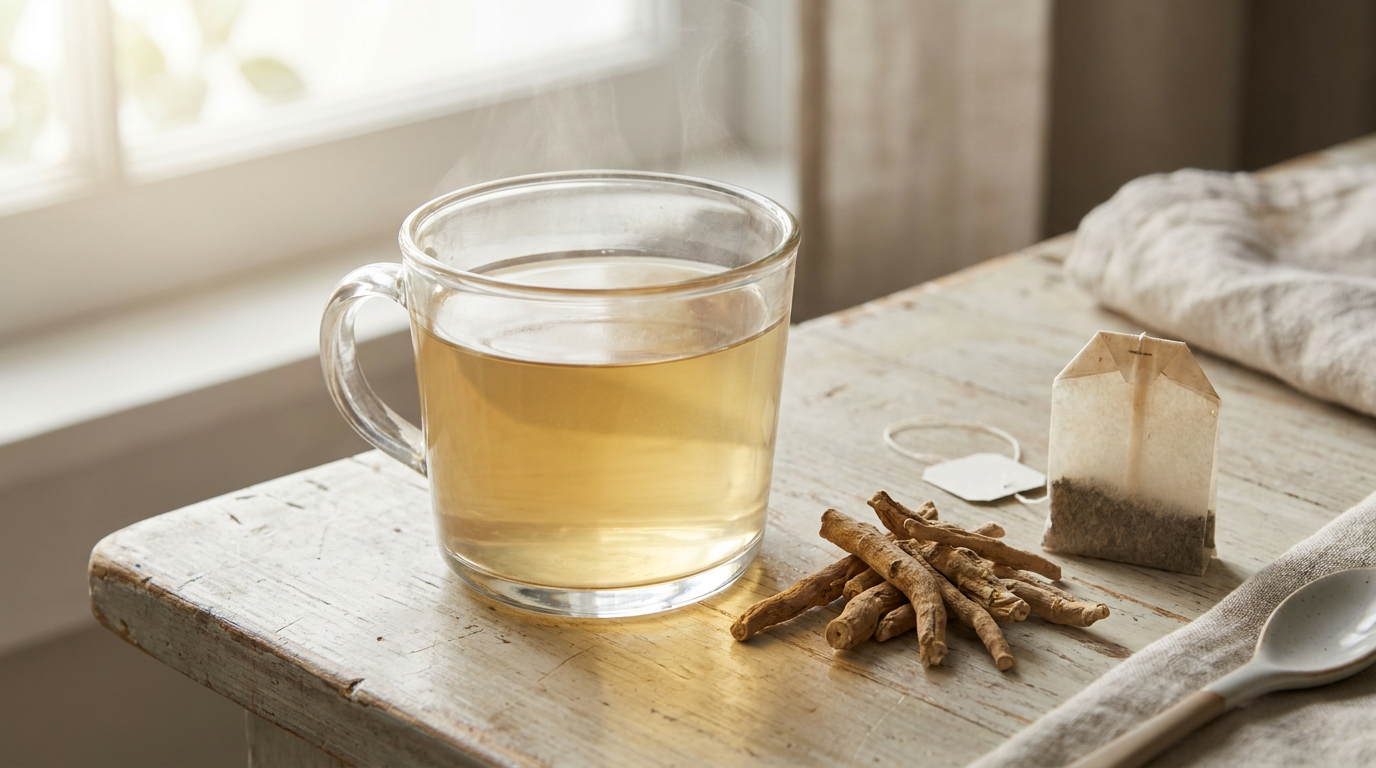
Ashwagandha tea is a pleasant, low-dose way to drink the root, but no clinical trial has tested it. The stress and sleep results you read about come from standardized capsule extracts taken daily for six to twelve weeks. A tea bag delivers an unmeasured amount of the compounds those trials counted.
What the ashwagandha trials actually measured
The NIH Office of Dietary Supplements summarises the human research, and every trial it describes used a root or root-and-leaf extract. Each extract is standardized to a stated level of withanolides, the steroidal lactones believed to drive most of the effect.
In one Indian trial, 130 stressed adults took 300 mg a day of an extract carrying 15 mg of withanolides for 90 days. They reported less stress and had lower serum cortisol than the placebo group. That is the study behind most cortisol claims on tea boxes.
Sleep data is thinner. A 2021 meta-analysis pooled five trials with 372 adults, all run in India. It found a small but significant sleep benefit, strongest at 600 mg a day and after at least eight weeks.
Not every trial won. A 12-week study of a 1.5% withanolide extract, taken twice daily, cut fatigue but left perceived stress no better than placebo.
Video: Dr Brad Stanfield
Trial extracts vs a cup of ashwagandha tea
Here is how the studied products compare with two tea bags sold in the US. Tea figures come from each brand’s own label, checked on 22 September 2026.
| Product and form | Daily amount | Withanolides stated | What was found |
|---|---|---|---|
| KSM-66 root extract (capsule) | 600 mg for 8 weeks | More than 5% | Better sleep quality and sleep onset in people with insomnia |
| Prolanza root extract (capsule) | 300 mg for 90 days | 15 mg per capsule | Lower stress scores and serum cortisol |
| Shoden root and leaf extract (capsule) | 120 mg for 6 weeks | 21 mg glycosides per 60 mg capsule | Larger sleep-quality gain than placebo (72% vs 29%) |
| Witholytin root extract (capsule) | 400 mg for 12 weeks | 1.5% | Less fatigue, perceived stress unchanged |
| Buddha Teas Ashwagandha (tea bag) | 2 g dried root per cup | Not stated | Never tested in a trial |
| Traditional Medicinals Stress Ease Calm (tea bag) | 381 mg ashwagandha blend per cup, 2 to 3 cups suggested | Not stated | Never tested in a trial |
Source: NIH Office of Dietary Supplements ashwagandha fact sheet (trial rows); Buddha Teas and Traditional Medicinals product labels, checked 22 September 2026.
Neither tea label states a withanolide content. Without that number, you cannot match a cup to any trial dose.
Why a tea bag is not a capsule
Trial extracts are concentrated before they reach the capsule. The Traditional Medicinals label shows the gap: its 381 mg is a mix of a 7:1 root extract and plain root, blended with shatavari, rose and honeybush.
A plain root tea such as Buddha Teas holds 2 g of dried root. How much of that root’s withanolide content reaches your cup has not been published for either product, and the brands even disagree on steeping: 3 to 5 minutes for one, 10 to 15 for the other.
Then there is duration. The positive trials ran for six weeks at minimum. An occasional evening cup is a much smaller exposure.
Where ashwagandha tea still makes sense
If you like the earthy taste and want a caffeine-free evening drink, a cup is a reasonable ritual. Treat it as a warm drink, and keep your expectations for stress relief modest.
If you want the effect the trials measured, the studied form is a standardized extract, and that choice is worth making with a clinician. The same rule applies to a magnesium complex supplement or vitamin D3 with K2: the form and dose used in the study decide whether its result transfers to you.
Be wary of teas sold with weight-loss or hormone promises. As with GLP-1 supplements, a bold label claim is marketing until a trial of that exact product backs it.
Who should skip ashwagandha, tea included
The NCCIH advises avoiding ashwagandha during pregnancy and while breastfeeding. It is also not recommended before surgery or for people with autoimmune or thyroid disorders.
It may interact with medicines for diabetes, blood pressure, seizures and thyroid conditions, as well as sedatives and immunosuppressants. Rare cases of liver injury have been linked to ashwagandha supplements, and Denmark banned ashwagandha in 2023, according to the ODS fact sheet.
Use of up to about three months looks well tolerated in trials, while long-term safety is unknown. This page is general information, not medical advice.
Ashwagandha tea: common questions
Does ashwagandha tea lower cortisol?
No study has tested tea. The cortisol drop comes from a 90-day trial of a 300 mg extract with 15 mg of withanolides. Tea labels do not state withanolide content, so that result cannot be assumed to carry over to a cup.
Can I drink ashwagandha tea every day?
Trials found extracts well tolerated for up to about three months, and long-term safety is unknown. Check with a clinician first if you take medication, are pregnant or have a thyroid condition.
Is ashwagandha tea good for sleep?
A warm, caffeine-free drink may help you wind down. The measured sleep benefit came from extracts at 120 to 600 mg a day over six weeks or more, and it was small.