
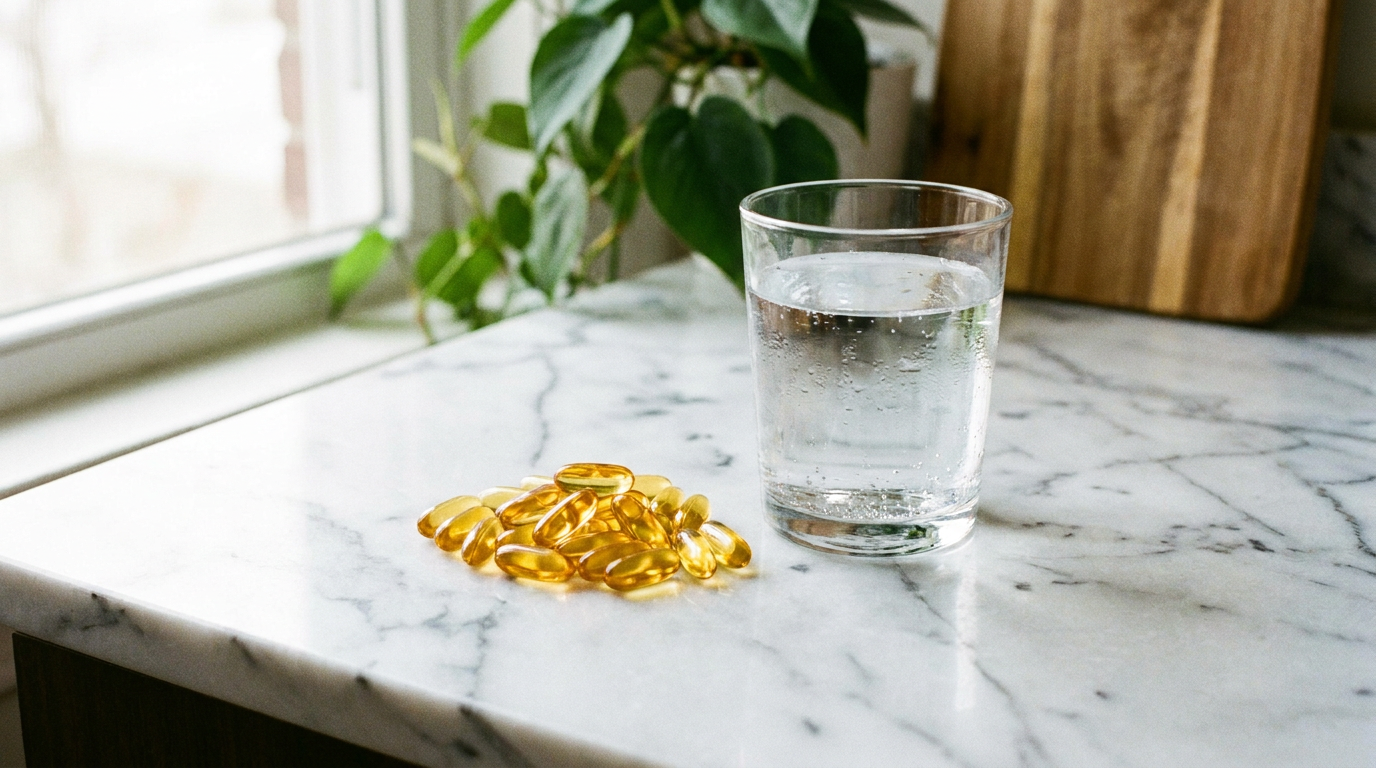
The best vitamin D supplement for women is the one whose Supplement Facts panel lists cholecalciferol (D3) in micrograms, at a dose you can defend against the 15 mcg (600 IU) adult RDA.
Sex is not a variable in that number. The NIH Office of Dietary Supplements gives women and men the same RDA in every age band, so a bottle marketed for women is a shelf position rather than a different dose.
The RDA Is Identical for Women and Men
NIH lists 15 mcg (600 IU) a day for everyone aged 1 to 70, then 20 mcg (800 IU) after 70. Pregnancy and lactation stay at 15 mcg (600 IU), the same figure as before pregnancy.
The tolerable upper intake level is 100 mcg (4,000 IU) a day from age 9 up, breastfeeding included. No women’s formula overrides either number.
Micrograms Are the Legal Number, IU Is Optional
Under 21 CFR 101.36, vitamin D must be declared in mcg, and expressing it in IU is optional and has to appear in parentheses after the mcg amount.
So the “5,000 IU” printed on the front of the bottle is 125 mcg on the panel. Measured against the FDA Daily Value of 20 mcg (800 IU), that prints as 625% DV.
It also sits well above the 4,000 IU upper limit, which is a conversation with your doctor rather than a shrug. A 600 IU softgel is 15 mcg and 75% DV.
D3, D2, and What “Plant Based” Means Here
Most evidence indicates D3 raises serum 25(OH)D further and holds it there longer, which is why D3 is the default pick. The pharmacy-counter version of that comparison is in the difference between D2 and D3.
D3 is usually produced from 7-dehydrocholesterol in lanolin, taken from sheep wool. A lichen-sourced D3 exists for anyone avoiding animal ingredients.
What the Bone Claim on a Women’s Label Rests On
Menopause is the honest reason these products get aimed at women.
NIH states that trials show vitamin D and calcium supplements may increase bone mineral density in some postmenopausal women and older men, but whether they reduce falls and fracture rates is not clear.
The US Preventive Services Task Force found insufficient evidence to weigh the benefits and harms of screening asymptomatic adults for deficiency, and NIH notes that no national professional organization recommends population screening. A “supports strong bones” line is a structure-function claim, not a fracture outcome.
Who the Supplement Is Actually For
NIH names limited sun exposure, darker skin, conditions that limit fat absorption, and obesity or gastric bypass surgery among the reasons status runs low. Those risk factors, not your sex, are what should drive the purchase.
Take it with food containing some fat, since fat in the gut enhances absorption.
If you would rather eat it than swallow it, vitamin D2 in food maps the mushroom and fortified routes. If your bottle also carries K2, pairing D3 with K2 covers what that combination is doing.
This is general information and not medical advice. Vitamin D interacts with several prescription medicines, so run any dose change past your clinician or pharmacist first.
Do women need more vitamin D than men?
No. NIH sets 15 mcg (600 IU) for both sexes from age 1 through 70, and 20 mcg (800 IU) after that.
Is a 5,000 IU capsule too much?
That is 125 mcg, above the 4,000 IU upper limit NIH lists for adults. NIH adds that toxicity signs are unlikely below 250 mcg (10,000 IU) a day, which is an observation about harm and not a green light.
Ask your clinician before running that high.
Should a women’s vitamin D include calcium?
The bone mineral density trials NIH cites involved vitamin D together with calcium. Whether that pairing lowers fracture risk is still unresolved, so treat the added calcium as convenience rather than proof.