Buy the D3. Both forms raise your blood level of vitamin D, but most evidence shows D3 (cholecalciferol) pushes serum 25(OH)D higher and holds it there longer than D2 (ergocalciferol).
That is the position of the NIH Office of Dietary Supplements, which reviewed the comparison trials.
D2 is not a scam. It is the second choice unless a prescription or a strict plant-only rule sends you there.
Ergocalciferol vs Cholecalciferol on the Label
The two words on the back panel tell you the source. D2 is made by shining UV light on ergosterol in yeast. D3 is usually made by irradiating 7-dehydrocholesterol taken from lanolin, the wax in sheep wool.
Chemically they differ only in their side-chain structures. Both absorb well in the small intestine by passive diffusion, and taking either with a meal that contains some fat improves absorption.
Most steps in how your body metabolizes and uses the two are identical. The split shows up in your blood level.
Why D3 Holds Its Level Longer
Both forms cure rickets, and ODS calls them equivalent for that. But when researchers measure serum 25(OH)D after equal doses, D3 wins on both size and duration of the rise.
That matters because 25(OH)D is the marker your doctor actually orders. Levels of 50 nmol/L (20 ng/mL) or above are considered sufficient for most people, and risk of deficiency climbs below 30 nmol/L (12 ng/mL).
Correcting a low reading and keeping it corrected between blood draws favors the form with the longer tail.
The same form-matters logic runs through other supplements, which is why magnesium glycinate and citrate behave differently despite carrying the same element.
The Sourcing Question If You Avoid Animal Products
Sheep wool is an animal product, so standard D3 is out for strict vegans. Two routes remain.
D2 from yeast is plant-and-fungus based by definition. There is also an animal-free D3 sourced from lichen, sold by a smaller set of brands.
Sourcing is rarely printed clearly, so ODS suggests contacting the manufacturer to ask about the raw material and processing.
Micrograms, IU, and the Number That Confuses Everyone
One microgram of vitamin D equals 40 IU. That conversion is the whole reason a bottle marked 25 mcg and a bottle marked 1,000 IU are the same dose.
Recommended intakes run 15 to 20 mcg (600 to 800 IU) daily for adults. The tolerable upper intake level is 100 mcg (4,000 IU) daily from age 9 up, and excess vitamin D is genuinely toxic rather than just wasteful.
If you are eyeing a combination product, read our notes on who should avoid stacking D with K2 before adding a second variable.
When a Pharmacist Hands You D2
Prescription ergocalciferol capsules are 1.25 mg, which the label states as 50,000 USP units. The FDA-approved indications on that label are hypoparathyroidism, vitamin D resistant rickets, and familial hypophosphatemia.
So if you walk out with D2, it was almost certainly a clinical decision, not a shelf accident. Take what your prescriber ordered and raise the form question with them, not with the internet.
For everyone buying over the counter without a specific reason to do otherwise, D3 is the default, and the D3 plus K2 pairing is the next question worth asking. This is general information, not medical advice.
Is vitamin D2 or D3 better absorbed?
Both are absorbed well in the gut. The difference is what happens afterwards: D3 raises serum 25(OH)D more and maintains the higher level for longer.
Can I take D2 and D3 together?
There is no reason to. They act through the same pathway, so stacking them only makes your total dose harder to track against the 100 mcg (4,000 IU) upper limit.
Do UV-treated mushrooms count as a vitamin D source?
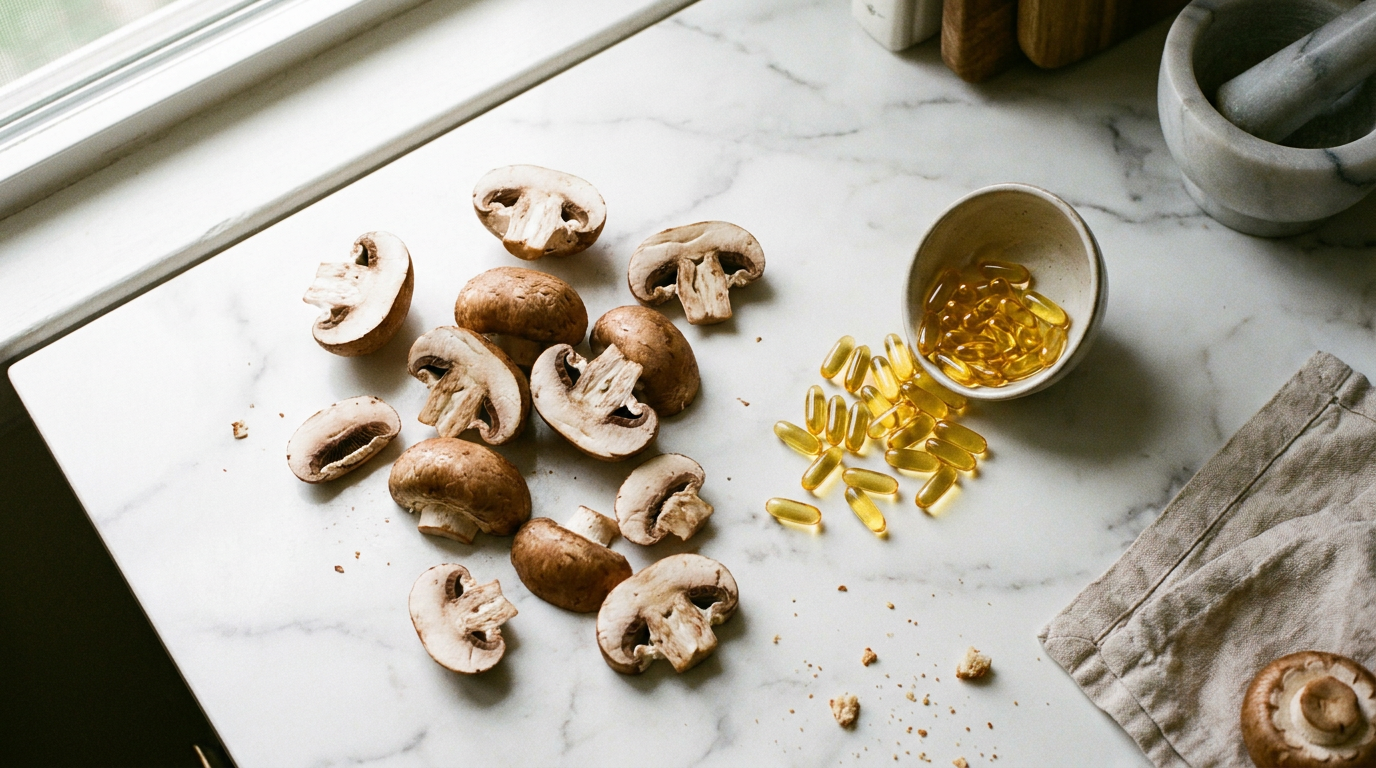
Yes, as D2. Mushrooms provide variable amounts, and the FDA has approved UV-treated mushroom powder as a food additive used to supply D2 in food products.