
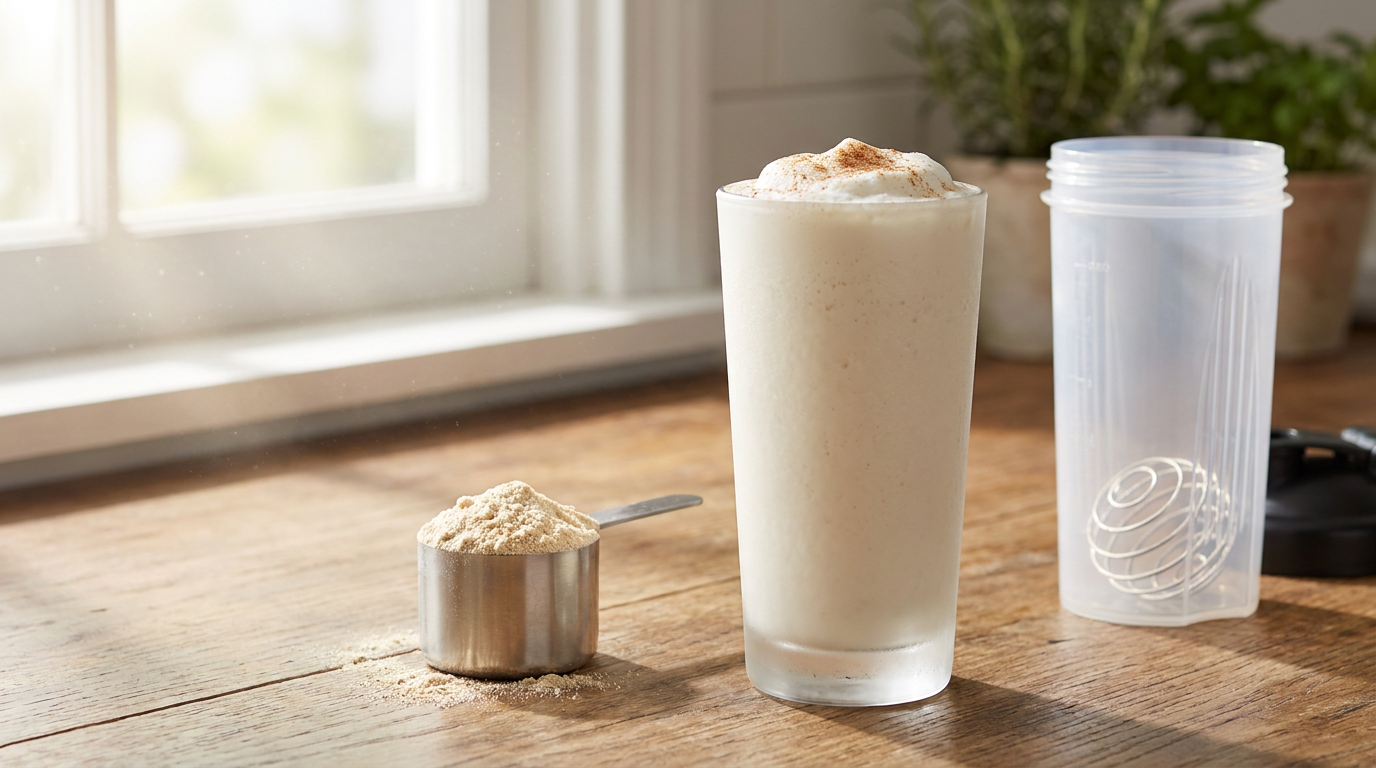
Protein shakes do one thing well: they deliver a measured dose of amino acids into your blood faster than most meals can. Everything else people credit them with, from muscle growth to fat loss, depends on what your body was short of when you drank it.
What happens in the first hour after you drink one
Digestion speed comes first. In a 1997 tracer study, Boirie and colleagues fed adults whey or casein and tracked labelled leucine for seven hours. Whey gave a sharp, brief spike in plasma amino acids. Casein gave a moderate plateau that lasted most of the test.
Boirie put the difference down to slower gastric emptying with casein. One proposed reason is that casein forms a semi-solid clot in the stomach, while whey stays liquid and leaves quickly.
A shake with nothing else in it amplifies this. Blend in peanut butter or oats and you have built a slower drink. That changes what it does, nothing more.
Video: Jeremy Ethier
What your muscles do with the amino acids
Once amino acids reach the blood, muscle protein synthesis rises. In Moore and colleagues’ 2009 dose study, 20 g of egg protein after leg training maximally stimulated synthesis in young men. Oxidation was already rising at 20 g, and 40 g pushed it further, so most of the extra was burned rather than built.
Witard’s 2014 trial found the same ceiling with whey isolate in trained men of about 80 kg. Twenty grams did the job, and 40 g raised urea production instead.
Leucine appears to be the trigger. Gorissen’s 2018 analysis puts it at 11 percent of whey protein against 8 percent of casein, which is why a smaller whey serving reaches the same leucine threshold.
Whey, casein and plant shakes compared
Tang and colleagues in 2009 matched drinks for 10 g of essential amino acids. Whey hydrolysate beat casein by roughly 93 percent for synthesis at rest, and soy sat between the two. The table pulls those trials together.
| Shake type | Protein needed for 2.7 g leucine (Gorissen 2018) | Digestion pattern | Muscle protein synthesis response |
|---|---|---|---|
| Whey | 25 g | Fast: sharp, short amino acid peak (Boirie 1997) | Highest of the three, at rest and after exercise (Tang 2009) |
| Casein | 34 g | Slow: moderate plateau across the 7-hour test (Boirie 1997) | Lowest of the three (Tang 2009) |
| Soy | 40 g | Fast (Tang 2009) | Between whey and casein (Tang 2009) |
| Pea | 38 g | Not measured in these trials | Not measured in these trials |
Pea protein was not part of those synthesis trials, so its row carries only the leucine figure. Treat any pea versus whey claim that arrives without a study attached as marketing.
The post-workout window is wider than the label says
The 30-minute rule is the most repeated piece of shake advice and the least supported. Schoenfeld, Aragon and Krieger’s 2013 meta-analysis covered 23 hypertrophy studies. Once total daily protein was controlled for, timing around the session made no significant difference.
Total intake was the strongest predictor. A shake earns its place when it gets you to your daily target, not because of the clock.
If you would rather chew, high protein snacks you can buy at the store cover the same gap with more food around the protein.
Shake versus whole food
Whole food is not simply a slower shake. Van Vliet’s 2017 crossover trial gave trained men 18 g of protein as whole eggs or egg whites after exercise. Leucine appeared in blood faster from the whites, yet the whole eggs drove greater myofibrillar synthesis.
Something in the food matrix, the fat, the micronutrients or both, did work that isolated protein did not. That is a reason to treat shakes as a supplement to meals rather than a replacement for them.
The Dietary Reference Intakes set adult protein at 0.8 g per kg of body weight, 56 g a day for a reference man. Trainees usually aim higher, and a protein snack drawer at work or a morning protein coffee closes that gap as well as a shaker does.
This is general nutrition information, not medical advice. If you have kidney disease or another condition that affects how you handle protein, ask your clinician before adding shakes.
Frequently asked questions about protein shakes
Do protein shakes work without exercise?
The amino acids still reach your blood and synthesis still rises, which is what Tang measured in the resting leg. The response is larger after training, and without training there is no extra stimulus to build on.
Is casein better before bed?
Casein’s slow release is real, per Boirie. Whether that becomes more muscle overnight is less settled, and the total protein you eat across the day matters more than which powder ends it.
What protein dose maxed out synthesis in the studies?
About 20 g of whey covered the synthesis ceiling in both Moore’s and Witard’s trials. With a plant powder, Gorissen’s leucine matching points to 38 g of pea or 40 g of soy protein to deliver the same 2.7 g of leucine.