
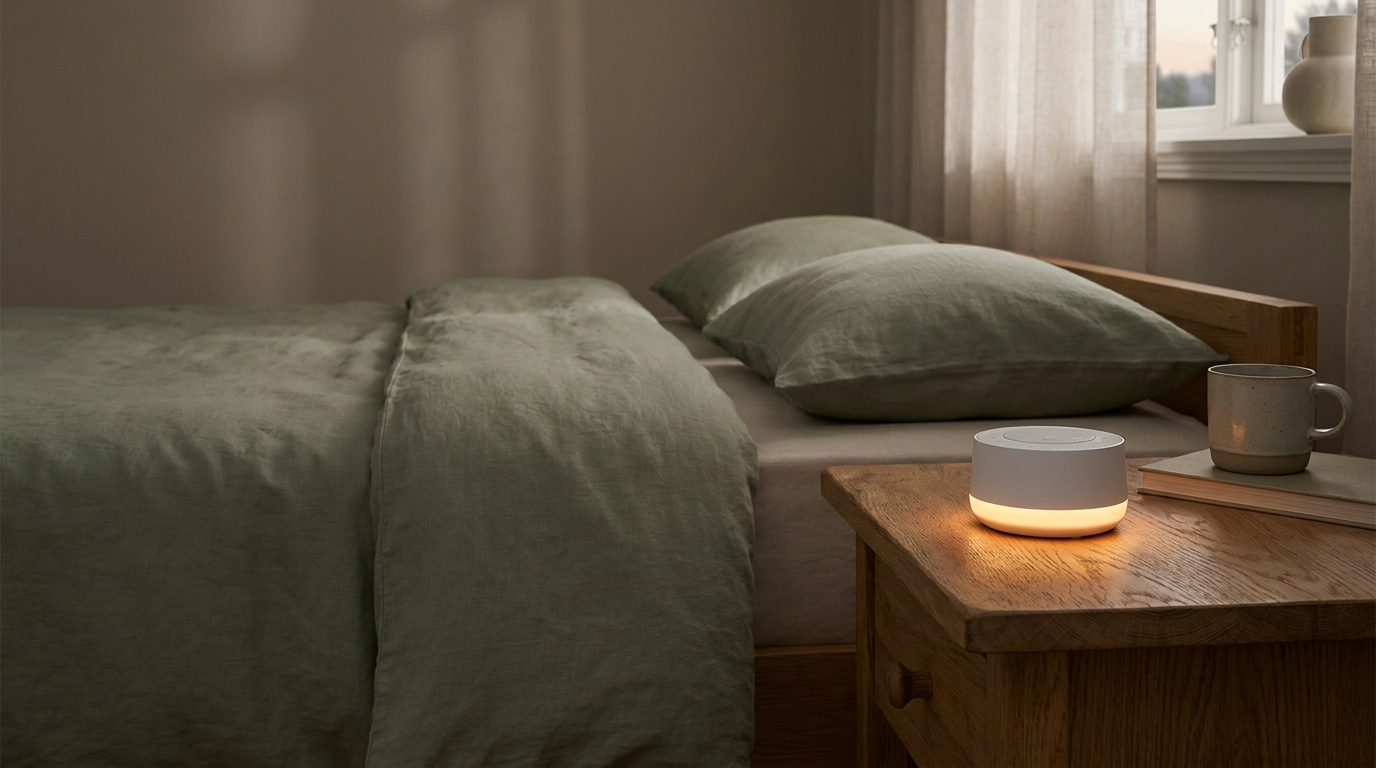
Green noise sleep claims have no direct evidence behind them. A PubMed search on 21 September 2026 for “green noise” and sleep returned zero records. Green noise may still cover disruptive sounds the way other steady noise does, but that is an inference from white and pink noise studies, not a finding.
What green noise is, and who defined it
Noise colors describe how sound energy spreads across frequencies. Cleveland Clinic says that white noise is balanced across everything humans hear, roughly 20 to 20,000 Hz, while pink noise turns the higher frequencies down.
Brown noise goes further. A Cleveland Clinic expert describes it as bass-heavy, with the lower frequencies played loudest.
Green noise has no such clinical definition. Sleep-product guides describe it as noise with its power centered around 500 Hz, roughly the middle of the hearing range. That definition comes from sellers and playlist makers, not from a sleep lab.
Video: Sleepopolis
What the research says about colored noise and sleep
A 2022 systematic review by Capezuti and colleagues in the Journal of Clinical Sleep Medicine covered 34 studies with 1,103 people: 18 tested white noise and 11 tested pink noise.
Six of the 18 white noise studies found better sleep, against nine of the 11 pink noise studies. The authors still concluded there was no strong evidence for auditory stimulation, though none of the studies reported harm from short-term use.
A 2021 review in Sleep Medicine Reviews by Riedy and colleagues went further. Across 38 studies of continuous noise, it rated the evidence that noise improves sleep as very low quality and warned it may also harm sleep and hearing.
In a Brigham and Women’s Hospital trial of 18 healthy adults, broadband sound at about 46 dB cut the median time to stage 2 sleep by 38 percent. Participants went to bed 90 minutes early to mimic short-term insomnia.
| Noise color | Frequency profile | Claimed use | Evidence status |
|---|---|---|---|
| White | Equal power across all audible frequencies | Masking noise, falling asleep faster | Most studied; 6 of 18 studies positive (Capezuti 2022) |
| Pink | Higher frequencies turned down | Steadier sleep, deeper sleep | 9 of 11 studies positive, small samples (Capezuti 2022) |
| Brown | Lowest frequencies loudest, deep rumble | Focus, relaxation, sleep | 3 PubMed records with sleep, no dedicated review |
| Green | Marketed as centered near 500 Hz | Calm, nature-like sleep sound | 0 PubMed records with sleep |
Sources: Cleveland Clinic Health Essentials (pink noise, brown noise); Capezuti et al., J Clin Sleep Med 2022; PubMed searches run 21 September 2026.
Why pink noise results do not carry over to a green noise track
The pink noise studies behind the deep-sleep headlines did not play a steady track. In Ngo 2013 (Neuron) and Papalambros 2017 (Frontiers in Human Neuroscience), short pulses were timed by a real-time EEG algorithm to hit the peak of each slow wave.
Even then, Papalambros found slow-wave activity across the whole night was similar to the sham night. A playlist cannot read your brain waves.
The steady pink noise study, Zhou 2012, measured “stable sleep” through an ECG method rather than standard EEG sleep staging.
Where the green noise claims break down
Check the citations on green noise pages. One sleep-brand guide on green noise links a “2020 study published in the Journal of Sleep Research.” The DOI resolves to a 2000 American Journal of Epidemiology paper on electric blankets and breast cancer.
The same guide’s other study link points to the Riedy review, the one that rated the noise evidence very low.
Volume is the other gap. A 2014 Pediatrics study of 14 infant sleep machines found every one exceeded 50 dBA at 30 cm at full volume, and three passed 85 dBA. For babies, the room setup in the Safe Sleep 7 method matters far more than a sound color.
How to test green noise without fooling yourself
- Pick one steady track with no ads, voices or audible loop point.
- Set the lowest volume that covers the sound that wakes you.
- Place the speaker across the room, not by your pillow.
- Log how long you take to fall asleep for two weeks, then two weeks of silence or white noise.
If you already use sleep music for deep sleep, test one change at a time. Trouble sleeping most nights is worth raising with a clinician, since chronic sleep debt affects the brain in ways a sound track will not fix. This page is general information, not medical advice.
Green noise and sleep: common questions
Is green noise better than white noise for sleep?
No study has compared them. White noise has at least 18 studies behind it, with mixed results. Green noise has none, so any claim that it beats white noise is a preference, not a finding.
Is brown noise or green noise better for sleep?
Neither has solid sleep research. PubMed lists three records pairing brown noise with sleep and none for green noise. Pick the one you find least intrusive at a low volume.
Is it safe to play green noise all night?
Short-term use looks low risk: the 2022 Capezuti review found no reported adverse effects. The Riedy review flagged possible effects on sleep and hearing, so keep the volume low and the speaker away from your head.