

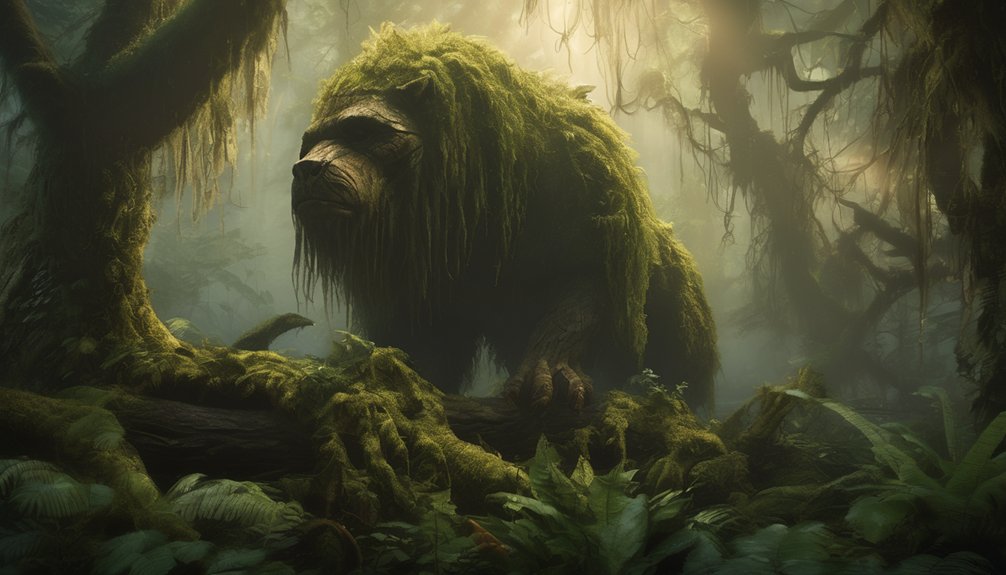
You might hear stories about giant sloths still living in remote South American forests, but scientific evidence shows they went extinct thousands of years ago. Fossils and genetic studies reveal they adapted to past environments, while climate shifts and human activity led to their disappearance. Some modern sightings are likely misidentifications or myths. Researchers continue to study fossils and ecological impacts to separate fact from fiction. Explore further to understand the full context behind these fascinating creatures.
Historical Background and Extinction of Giant Sloths
Although giant sloths once roamed vast areas of the Americas, they’re now extinct, leaving behind only fossilized remains and traces in the archaeological record.
You can learn about their existence through paleontological evidence found in prehistoric habitats, where these massive creatures thrived. Fossils reveal their adaptation to diverse environments, from forests to grasslands.
Understanding their extinction involves studying climate changes and human influences that disrupted these habitats. By examining this historical background, you gain insight into the giant sloths’ role in ancient ecosystems and the factors that led to their disappearance, emphasizing the importance of preserving natural freedom in today’s world.
Modern Sightings and Reported Encounters
Where have reports of giant sloth sightings emerged in recent years, and what do they reveal about these creatures?
Recent sightings mainly come from remote areas in South America, especially dense forests and mountainous regions. Eyewitness accounts describe large, slow-moving animals resembling ancient giant sloths, though details vary.
These reports often surface from locals and explorers who emphasize the creatures’ considerable size and unique gait. While such accounts spark curiosity, they remain anecdotal without physical evidence.
Still, these modern sightings suggest that stories of giant sloths persist in public imagination, reflecting a continued fascination with these prehistoric animals and their possible survival.
Scientific Perspectives and Ongoing Research
Since giant sloths disappeared from the fossil record thousands of years ago, scientists rely on a combination of paleontological evidence and modern technology to study these creatures.
You can explore genetic analysis, which helps reconstruct sloth DNA and understand their evolutionary history. Researchers also examine the ecological impact these animals had on their environments, revealing how their extinction altered ecosystems.
Ongoing research uses advanced tools like radiocarbon dating and environmental DNA sampling to verify findings. By staying informed about these scientific perspectives, you gain a clearer understanding of giant sloths while separating fact from fiction in ongoing debates.
Frequently Asked Questions
What Did Giant Sloths Eat in Their Natural Habitat?
You’d find giant sloths thriving on a herbivorous diet, munching leaves, fruits, and shoots. Their feeding behavior showed patience and freedom, letting them roam vast forests, embracing nature’s bounty without restriction or rush.
How Large Did Giant Sloths Typically Grow?
You’ll find size variations among giant sloths, with some reaching up to 20 feet long. Weight estimates vary too, often between 2,000 to 4,000 pounds, showing how massive and free these creatures once were.
Were Giant Sloths Social Animals or Solitary?
You’ll find giant sloths were mostly solitary, not favoring social behavior or group dynamics. They thrived independently, embracing freedom and solitude rather than the constraints of constant company or communal living.
What Predators Threatened Giant Sloths Historically?
You’d find that giant sloths faced threats from saber-toothed cats and large carnivores, whose predator adaptations thrived in prehistoric ecosystems. Their agility and strength challenged the sloths’ slow, solitary nature, shaping survival strategies.
How Do Giant Sloths Compare to Modern Sloth Species?
You’ll notice giant sloth adaptations made them massive and slow but powerful, unlike modern sloth behavior, which focuses on stealth and energy-saving. You’ll appreciate how both thrive in freedom, each mastering survival their own way.

