

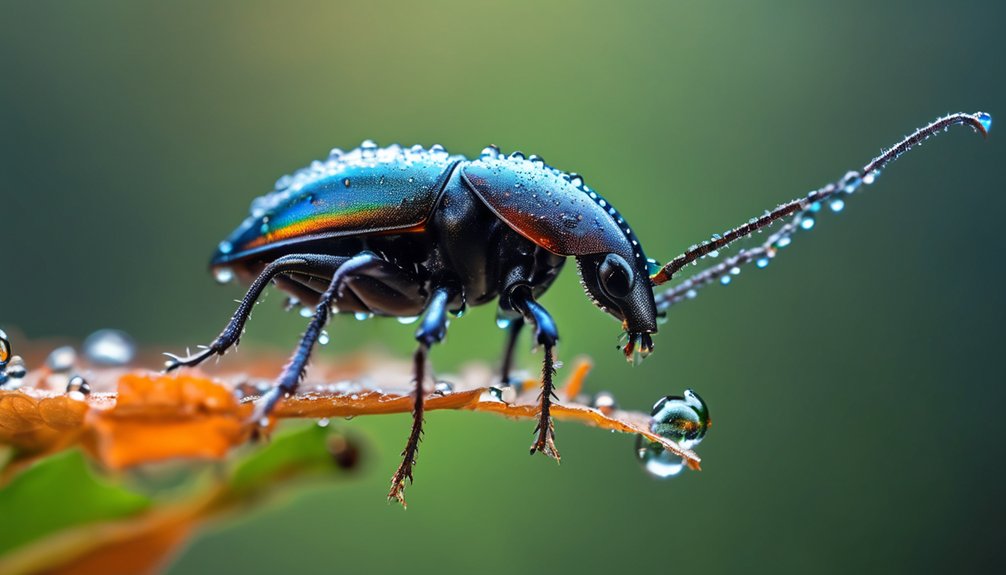
You control a small chamber where two chemicals—hydroquinones and hydrogen peroxide—are stored separately to prevent premature reactions. When threatened, these chemicals are mixed with enzymes, triggering a rapid reaction that produces heat, gas, and a hot, noxious spray. Muscular valves regulate the flow, aiming the spray precisely to deter predators without harming the beetle. This efficient process highlights sophisticated biological controls and chemical engineering. Discover how this defense shapes the beetle’s survival strategies.
Anatomy of the Bombardier Beetle
The anatomy of the bombardier beetle features specialized structures that enable its unique defense mechanism.
You’ll notice morphological adaptations such as a dual-chambered abdomen designed for storing reactive chemicals separately. These chambers connect to a mixing chamber where the chemicals combine explosively when threatened.
The beetle’s muscular valves control this mixing process precisely, allowing it to eject a hot, noxious spray. These defensive mechanisms are finely tuned to protect the beetle from predators without harming itself.
Understanding these adaptations helps you appreciate how evolution equips organisms with effective survival strategies by modifying their physical structures for specific functions.
Chemical Components Involved in the Explosion
Although the bombardier beetle’s explosive defense may seem mysterious, it relies on a combination of specific chemical compounds stored separately within its body.
You’ll find hydroquinones and hydrogen peroxide held in distinct reservoirs. When these chemicals mix, they initiate a rapid chemical reaction that generates heat and gas.
This process is central to the beetle’s defensive mechanism, allowing it to eject a hot, noxious spray at predators. Understanding these chemical components is key to appreciating how the beetle controls such a precise and effective explosion without harming itself.
The Reaction Process Inside the Beetle
When hydroquinones and hydrogen peroxide combine inside the bombardier beetle, they encounter enzymes that trigger a rapid chemical reaction.
These enzymatic triggers initiate complex reaction mechanisms, breaking down hydrogen peroxide and oxidizing hydroquinones. This process produces oxygen gas, heat, and benzoquinones, which build pressure within the beetle’s reaction chamber.
The swift release of energy propels a hot, noxious spray used for defense. Understanding these reaction mechanisms helps you appreciate how the beetle transforms simple chemicals into a powerful, controlled explosion.
This natural process exemplifies efficient bioengineering through precise enzymatic control and rapid chemical transformation.
How the Beetle Controls the Reaction
Controlling the intense chemical reaction inside its body requires precise coordination.
The beetle employs specialized behavioral mechanisms to regulate when and how the chemicals mix, preventing premature explosions. It stores reactive substances separately and releases them only upon threat detection, ensuring safety and effectiveness.
By controlling the flow and timing, the beetle directs the hot, noxious spray exactly where needed. These survival strategies allow it to conserve energy and reduce self-damage.
Understanding this control highlights the beetle’s sophisticated adaptation, showcasing how behavioral mechanisms and physiological processes work together to manage a powerful defense system efficiently.
Ecological Significance of the Chemical Defense
The chemical defense of the bombardier beetle plays a crucial role in its survival within various ecosystems. You’ll find that this defense offers significant evolutionary advantages by effectively deterring predators.
When threatened, the beetle emits a hot, noxious spray that discourages attacks, allowing it to escape danger. This mechanism not only protects the beetle but also influences predator-prey dynamics, maintaining ecological balance.
Frequently Asked Questions
Can Humans Replicate the Beetle’s Chemical Explosion Technology?
You can’t exactly replicate the beetle’s explosions, but biomimetic applications in chemical engineering let you mimic its rapid reactions. This inspires innovative tech, giving you freedom to explore powerful, safe chemical processes in new ways.
How Long Has the Bombardier Beetle Existed Evolutionarily?
You’ll find the bombardier beetle’s evolutionary history stretches back over 40 million years, supported by fossil evidence. This long existence highlights nature’s freedom to innovate complex defense mechanisms over time.
Are There Any Predators Immune to the Beetle’s Defense?
Yes, some predators have adaptations letting them withstand the beetle’s defense. You’ll see evolutionary resilience in those predators, showing nature’s balance. You can appreciate how freedom in survival drives these ongoing adaptations.
What Habitats Are Bombardier Beetles Typically Found In?
You’ll find bombardier beetles thriving in forest habitats and even desert environments. They adapt well, so whether you’re exploring dense woods or arid lands, these resilient beetles are ready to surprise you wherever freedom leads you.
How Do Scientists Study the Beetle’s Explosive Mechanism Safely?
You use safety protocols and wear protective gear while conducting chemical analysis to study the beetle’s explosive mechanism. This approach lets you explore freely without risking harm from the beetle’s powerful chemical defense.

